Life in Christie Walk, Adelaide
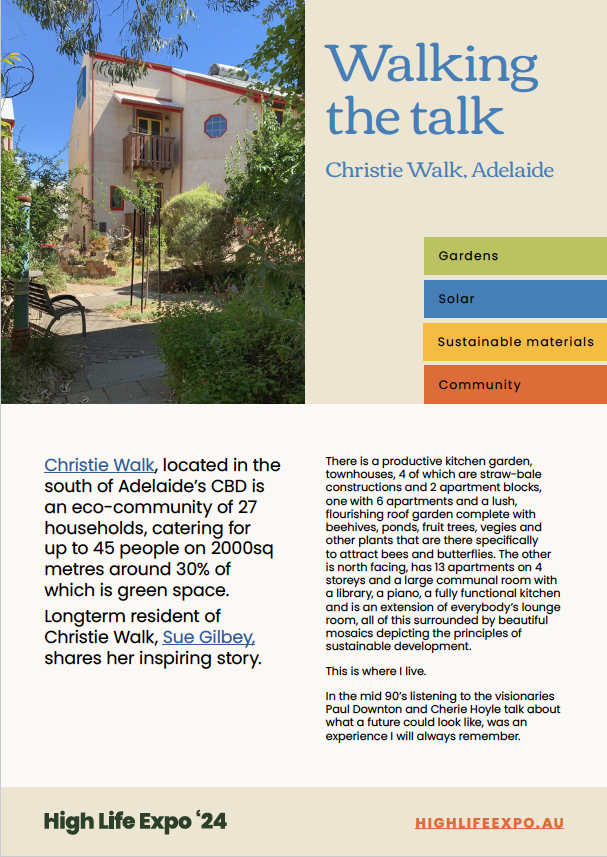
Christie Walk, located in the south of Adelaide’s CBD is an eco-community of 27 households, catering for up to 45 people on 2000sq metres around 30% of which is green space.
Long-term resident of Christie Walk, Sue Gilbey, shares her inspiring story.
There is a productive kitchen garden, townhouses, 4 of which are straw-bale constructions and 2 apartment blocks, one with 6 apartments and a lush, flourishing roof garden complete with beehives, ponds, fruit trees, vegies and other plants that are there specifically to attract bees and butterflies. The other is north facing, has 13 apartments on 4 storeys and a large communal room with a library, a piano, a fully functional kitchen and is an extension of everybody’s lounge room, all of this surrounded by beautiful mosaics depicting the principles of sustainable development.
This is where I live.
In the mid 90’s listening to the visionaries Paul Downton and Cherie Hoyle talk about what a future could look like, was an experience I will always remember.
I resolved then, that I would live where they built. And their vision came true with Christie Walk. Paul’s catch cry was the city can save the world, and it’s true, it can. If city apartment blocks were built to emulate Christie Walk there would be countless less laundries, cars, car parks, carbon emissions, countless more communal spaces, green spaces, solar panels, birds, lizards, bees, butterflies, trees, walkways, happy people, and the list goes on. And city living would be cheaper.
While it sounds and is idyllic none of the development was easy and there were many dedicated people who volunteered, invested, and were involved in making Christie Walk happen. Many lessons were learned along the way which could be useful for future buildings, which is in part why I wanted to write this story. We have proven it can be done, so it can and should be replicated.
Urban Ecology Australia was the organisation that facilitated the development of Christie Walk.
While Christie Walk has many similarities with co-op housing in that there are many shared resources, shared community meals and working bees, shared water bills even, it is not run in accordance with co-op principles. There are 3 community corporations representing the 3 stages of building.
I am writing this as my story as a resident, having been involved and watching it develop from the early days, from when it was just a twinkle in the eye, to participating in the laying of the straw bales for the first house, and then watching as each stage of the development progressed.
Along the way I acquired a disability and access became an issue which was taken into consideration in the development of the third stage. Now in my 18th year as a resident, I look around the beautiful gardens and I can’t think where else I would live.
Urban Ecology’s Christie Walk tours for members of the public, school groups, urban planners, decision makers and developers are provided with the goal of demonstrating how we can transform our cities into thriving, dynamic and self-sustaining places.
Funding sustainability in perpetuity
Sustainability is never a done deal. There’s always room for more improvement. Fortunately, the founding residents of Christie Walk had the foresight to initiate a Green Fund, which created a circular business model.
It works like this: Income and savings made through sustainability projects at Christie Walk - such as an upgrade of our PV solar - are put back into the Green Fund. The accumulating capital in the Green Fund is then used for the next sustainability upgrade in a continuous virtuous circle. In this way we were able to finance $74k worth of green projects over 5 years - 2016 to 2021 - and those projects also attracted another $16k of grants.
Learn More
There is much more information on the Urban Ecology website
Christie Walk becoming a carbon neutral ambassador
Installing a second Tesla Powerwall, funded by the Green Fund